
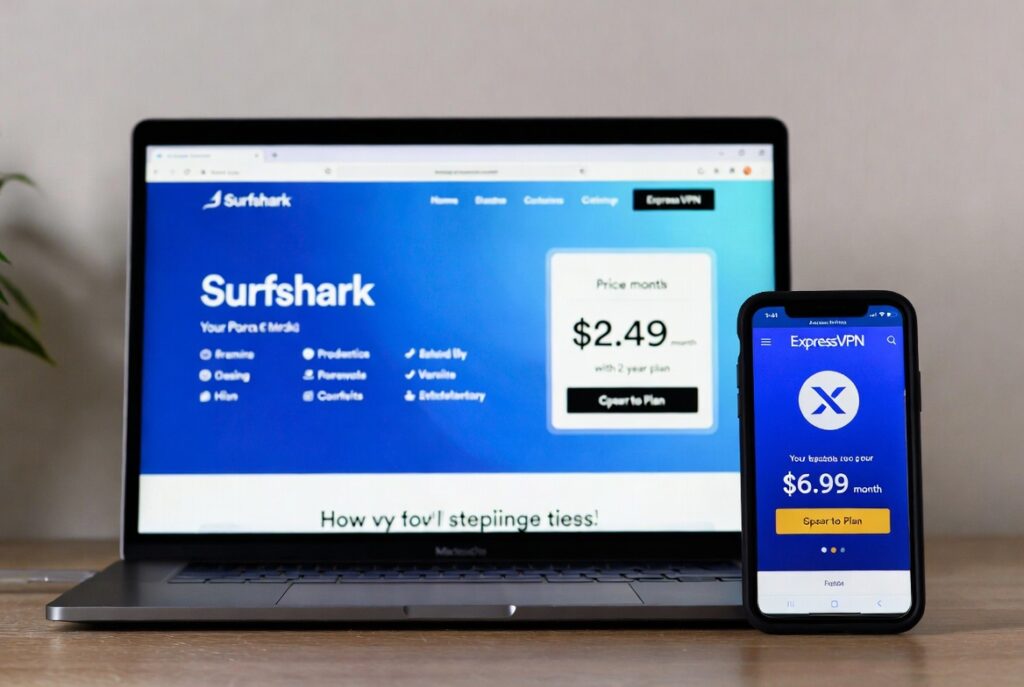
Surfshark and ExpressVPN sit at opposite ends of the VPN price spectrum. ExpressVPN at $6.67/month is one of the most expensive mainstream VPNs. Surfshark at $1.99/month is one of the most affordable. The $4.68/month difference sounds simple, but across a 2-year subscription it represents $112 — enough to buy additional security software, a password manager, or other services. This comparison determines whether ExpressVPN’s premium is justified.
Quick Comparison
| Feature | ExpressVPN | Surfshark |
|---|---|---|
| Max Speed | 680 Mbps | 650 Mbps |
| Servers | 3,000+ in 105 countries | 3,200+ in 100 countries |
| Connections | 8 | Unlimited |
| Price/month (2yr) | $6.67 | $1.99 |
| Ad blocker | Partial (Threat Manager) | ✅ CleanWeb 2.0 |
| Alternative ID | ❌ | ✅ |
| IP rotation | ❌ | ✅ Nexus |
| RAM-only servers | ✅ TrustedServer | ❌ |
| Audit history | KPMG + PwC | Cure53 |
Speed: Nearly Identical
ExpressVPN averages 680 Mbps; Surfshark averages 650 Mbps. That 4.4% speed difference is imperceptible in practice. Both are fast enough for 4K streaming, gaming, and heavy downloading. The speed argument for choosing ExpressVPN over Surfshark does not hold up in real-world use.
Security Architecture: ExpressVPN’s Genuine Advantage
ExpressVPN’s TrustedServer technology — where all servers run on RAM without writing to disk, verified by third-party audits — is a genuine security differentiator. Surfshark does not use RAM-only servers. ExpressVPN’s no-logs audit history (both KPMG and PwC) is more extensive than Surfshark’s (Cure53 only).
For users who prioritize the most rigorous privacy verification, ExpressVPN’s architecture is meaningfully stronger. For the average user, both are more than adequately secure.
Features: Surfshark Wins on Breadth
Surfshark’s feature set has expanded dramatically since Nord Security acquisition:
- CleanWeb 2.0: Blocks ads, trackers, malware, and phishing — more comprehensive than ExpressVPN’s Threat Manager (which only blocks malware domains, not ads)
- Alternative ID: Generate fake online identities — no equivalent in ExpressVPN
- Nexus: Continuous IP rotation — no equivalent in ExpressVPN
- Surfshark Alert: Real-time data breach monitoring
- Unlimited connections: vs ExpressVPN’s 8-device limit
Streaming: ExpressVPN’s Slight Edge
ExpressVPN maintains a small but consistent advantage in streaming reliability, particularly for BBC iPlayer (98% vs Surfshark’s 92%) and DAZN. For Netflix, Disney+, and Hulu, both perform equally well with 95%+ success rates.
Router Support: ExpressVPN Wins
ExpressVPN’s router app and custom firmware support is significantly more polished than Surfshark’s. For users who want VPN protection at the network level (protecting smart TVs, gaming consoles, and IoT devices), ExpressVPN’s router integration is a meaningful advantage.
The Price Reality: 2-Year Cost Comparison
- ExpressVPN 2-year cost: $6.67 × 24 = $160.08
- Surfshark 2-year cost: $1.99 × 24 = $47.76
- Difference: $112.32 saved with Surfshark over 2 years
For that $112 difference, Surfshark also gives you unlimited devices vs ExpressVPN’s 8, more innovative features, and a better ad blocker.
When to Choose ExpressVPN Over Surfshark
- You specifically need the best BBC iPlayer reliability
- You want VPN on a home router with the best setup experience
- You require TrustedServer RAM-only architecture for maximum privacy
- You want the most extensively audited no-logs policy available
Final Verdict
Surfshark delivers 95% of ExpressVPN’s performance at 30% of the price, with additional features like unlimited connections, CleanWeb 2.0, Alternative ID, and Nexus that ExpressVPN does not offer. For the vast majority of users, Surfshark is the smarter purchase. ExpressVPN justifies its premium only for specific use cases — router VPN setup and maximum BBC iPlayer reliability being the strongest arguments. Our ratings: Surfshark 4.7/5 for value, ExpressVPN 4.8/5 for raw performance.